


The ocean scares the shit out of me. Most large bodies of water do, honestly. I don’t like swimming at the beach, because just the thought of some unknown (probably harmless) creatures moving beneath my body drives me nuts. Flying over the Pacific was one of the most frightening experiences I’ve ever had. And yet, swimming next to a humpback whale in the open ocean of French Polynesia was among the most special things that have ever happened to me.
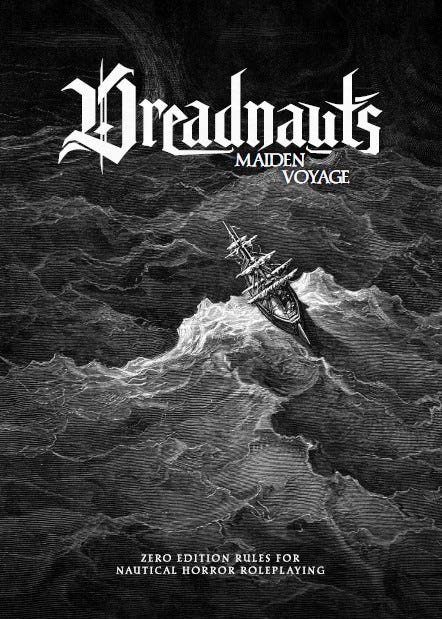
So maybe it’s less of a coincidence than I thought that I’ve so far written adventures for Pirate Borg (by Luke | Limithron), Benthic (by Thomas Zitzkeviz), and Islands of Weirdhope (by Copy/Paste Co-Op)—all games with a nautical theme. And now there it is: A TTRPG to bring all my fears to the table: Dreadnauts, a Nautical Horror Roleplaying Game by Hexplore RPG Substack (Luiz Ricon) and published by Plus One EXP, based on Mothership’s Panic Engine (by Sean McCoy), with art and layout by Mike Rieman.
When I heard about that most fitting combination—Nautical Horror and Panic Engine—I had to dig deeper. So I asked Luiz to tell me what exactly he has waiting for us beneath the waves.
The Interview
Golem Productions (G.P.): Welcome, Luiz. Thanks for stopping by. Could you introduce yourself?
Luiz: Hi Alexander, thanks for having me. My name is Luiz Ricon, I live in Rio de Janeiro, Brazil, and I’ve been professionally involved with RPGs since the early 1990’s. I created the first RPG based on Brazilian History and folklore in 1992. After that, I worked for the publisher of Brazilian editions for major games like D&D to Vampire, Cyberpunk 2020, Shadowrun etc. But by 2022, I started writing in English and publishing adventures - as a hobby - on DriveThruRPG. Dreadnauts is my first ‘serious’ foray into the international TTRPG scene.
G.P.: Adopting the Panic Engine to Nautical Horror immediately seemed like a natural fit to me. How did you come to that idea and how long have you been working on the game?
Luiz: I always had the desire to create a TTRPG about the Age of Sails. It always seemed to me to be a great time for adventure. Getting into a wooden ship and crossing the Atlantic was something as bold as the Apollo missions, if not more!
When I discovered Mothership, everything ‘clicked’ and I started to work with a rudimentary idea. It was only after I watched the AMC series The Terror, that I knew I HAD to write this game! So, I started my research while developing the rules, adapted straight from the Panic Engine. In the meantime, I started promoting the project in Mothership communities and that’s how I met Tony Vasinda from Plus One Experience, who offered to publish the book. It took me a bit over a year to get to the final manuscript.
G.P.: How would you define Nautical Horror?
Luiz: The sea can be a haunting and terrifying place. Anyone who experienced a storm on a boat or ship knows what I’m talking about. Nautical Horror picks up on this untamable nature of the sea to create the atmosphere of isolation, dread and desperation. It is a very specific kind of horror that pitches humans against the forces of nature and the supernatural, treating the sea not only as a backdrop, but almost like a character itself. I guess my love for the genre also comes from the fact that my father and my grandfather used to fish, and I was exposed to the sea from an early age.
G.P.: On Facebook, someone said that Dreadnauts was right up their alley, but they were curious about exactly what time period/sub-genre you want us to lean into. What is your answer to that? Does your game have a default setting?
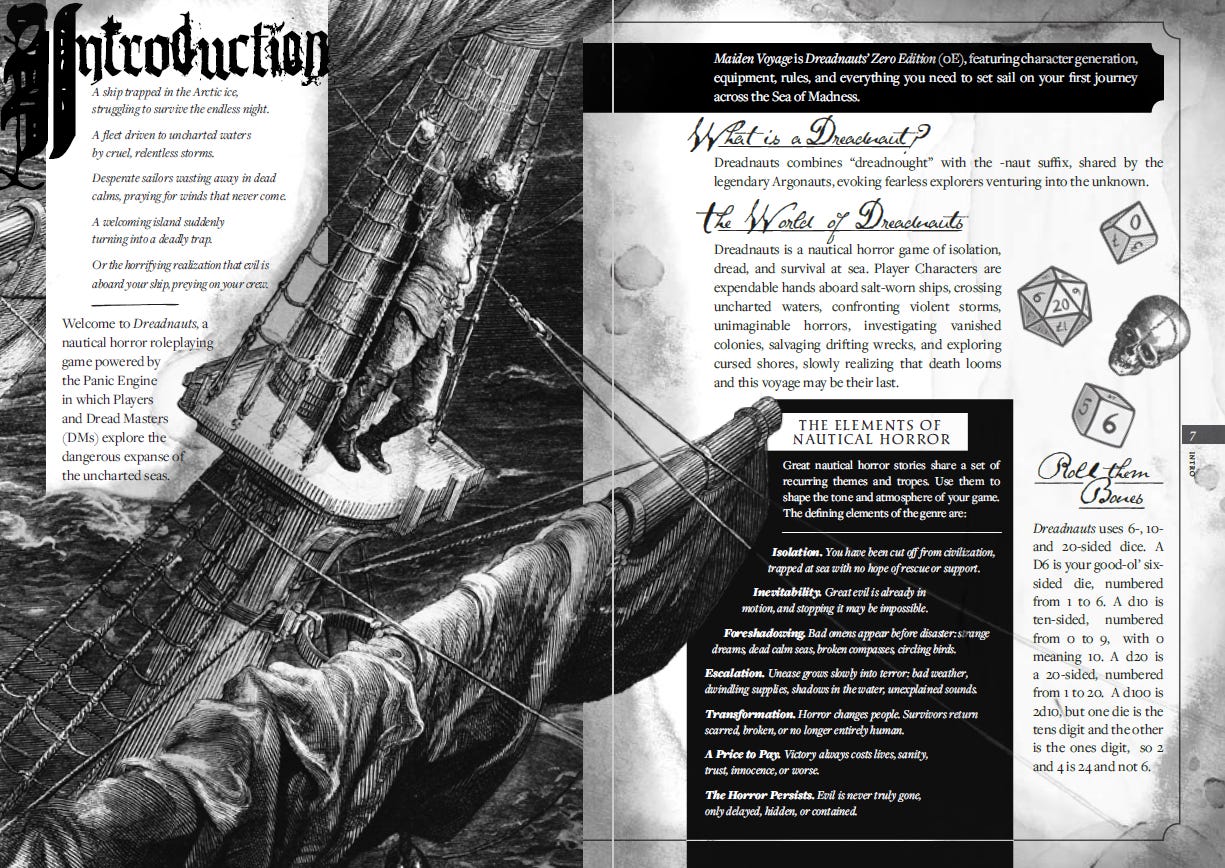
Luiz: Well... I guess so. But a very loose one. If you read between the lines, there are some basics. There are mentions to a “Company”, some hints about religion, colonization etc. Basically, the setting is a world of declining kingdoms, mercantile city-states, colonial frontiers and a powerful trading corporation whose influence often extends beyond that of kings. Religion, commerce and colonial expansion are important parts of the setting, but beneath all of them lies something much older and far less understandable.
We’ll be developing and publishing setting materials, but generally, Dreadnauts is a nautical horror game about crews facing the dangers of the sea, and the powers of the unknown during the Age of Sail. It can support exploration, piracy, naval expeditions, colonial frontiers, Arctic voyages, and supernatural horror, but the common element is that the sea is vast and full of horrors, both above and below the waves.
Initially, I wanted people to jump right into it and start creating their own stuff. But I recognize we need to point the right direction. We’re already tossing around some ideas. When I say we, I mean me, Tony Vasinda, and Chris Airiau, who helped me shape the game in terms of rules and integration with the Panic Engine.
G.P.: The Panic Engine is famous for generating claustrophobic tension in deep space. How did you adapt its core mechanics to capture the unique feeling of seafaring horror?
Luiz: I basically looked at the structural elements of Mothership and tried my best to ‘translate’ them into a nautical horror setting. The cramped, unsavory lower decks of wooden ships seemed perfect for the kind of atmosphere I was going after. And I think all the basics of Mothership apply to Dreadnauts as well: the vast unknown, strange and deadly creatures, isolation and impotence against the forces of nature.
G.P.: Is there a difference between Mothership’s Stress/Panic and your Dread/Terror?
Luiz: Not really, just stylistic, I guess. I looked at other Panic Engine games (Cloud Empress, Ruination Pilgrimage, and more recently Fatherfog) and adopted some of their solutions. One of them was to rename some of the mechanics. I tried to strike a balance between what I kept and what I ended up changing, because I wanted Dreadnauts to be familiar to Mothership players.
We just recently reviewed Fatherfog, the new Fairytale Horror Game by Tuesday Knight Games.
Coffee Review: Fatherfog (Zero Edition)

I love Mothership. I mean, I haven’t played as much of it as I wanted to but all my one- and few shots have been memorable. I adore the work of Sean McCoy and his team, who put out one of the leanest, clearest, easiest to understand rulebooks I’ve ever seen, dripping with SciFi horror atmosphere with an elegant system. It’s no coincidence that their
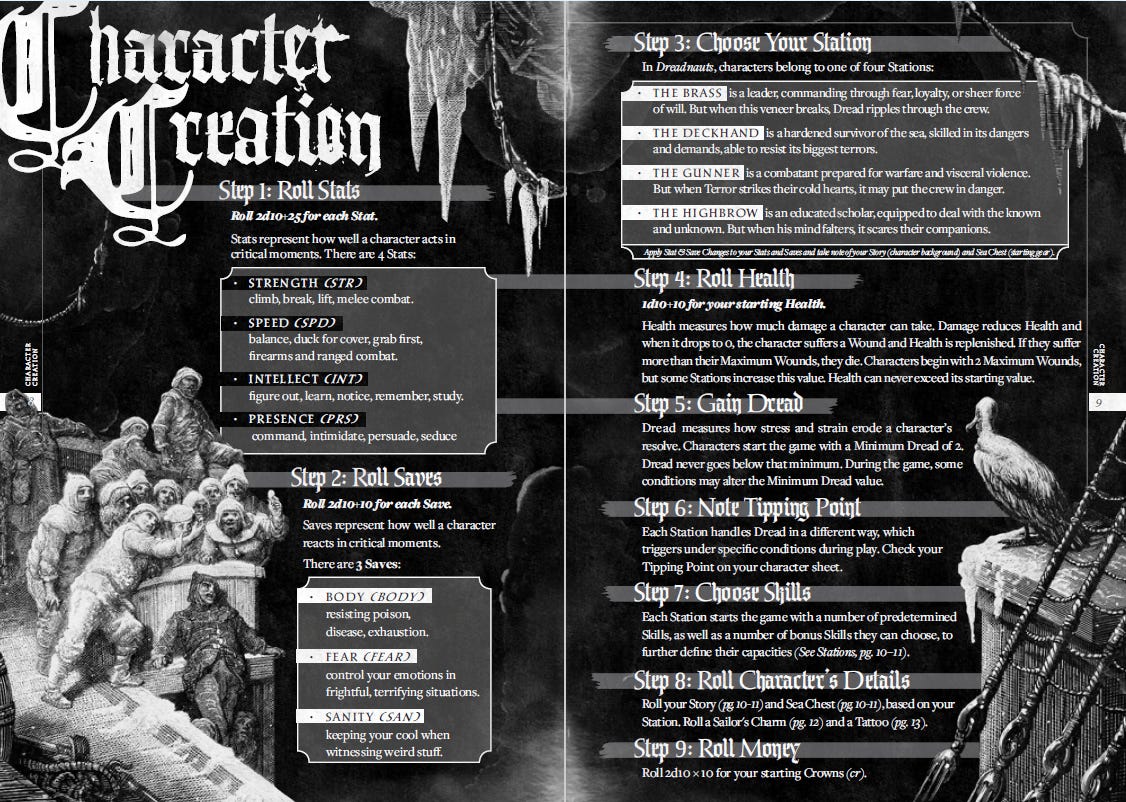
G.P.: Your Station (Character Class) design in Dreadnauts (The Brass, Deckhand, Gunner, Highbrow) mirrors the design of Mothership’s classes. What’s your idea behind them?
Luiz: It’s a double edge sword: on one side I wanted Mothership players to feel ‘at home.’ On the other hand, I needed to create broad archetypes aligned with the setting. The major difference is the Brass - I had to create a ‘commander/officer’ class and that led me to another change which was to replace the Combat Stat with Presence. The other Stations perform important ‘tasks’ in narrative terms, and each gets a ‘domain’ of action, where they can shine.
The last one to be created was the Highbrow. Initially it was the Surgeon but I kept missing out on other important character archetypes such as a Naturalist, a Navigator, a Cartographer, a Chaplain and others. The Highbrow was my attempt to create a one-size-fits-all solution, so players can specialize their characters in whatever area they want.
G.P.: So, who actually are the player characters?
Luiz: The idea is that the PCs are serving on a ship where they are part of the crew. But they are the ‘protagonists’. The rest of the crew is composed of either hired NPCs or a singular, collective element (the crew) treated as one ‘character’ when rolling checks, saves etc. The game assumes you’ll be playing during the Age of Sails (somewhere between the 16th and 19th centuries), but nothing stops you from playing in steam powered ships (like in The Terror), but that will require some tinkering.
G.P.: Why did you decide against Skill trees that we know from Mothership and Fatherfog? Personally, I was always thrilled by that concept.
Luiz: Yeah… that was a hard one. I tried multiple options of skill trees but during playtest, my players were taking a little bit longer to understand if they needed to add 10, 15, or 20 to the stat and make the calculations. This slowed the game and it compounded to harm the pacing. So, to make things more agile and fluid I decided skills will simply grant +10 to the checks. And since that applied to all skills, there was no need for hierarchy between skills. And players get it really fast.
G.P.: You treat ships like characters and put a lot of design effort into them. Mothership has a full zine about ships, ship combat, upgrades, and so on, but I see it rarely used in 1st or 3rd party modules. How will it be with Dreadnauts? Do you think those ship-related rules will play a big role in your everyday sessions?
Luiz: Excellent question! Actually, a huge chunk of the Ships chapter was cut off. It originally included a more detailed naval combat system, tables and procedures for travels and exploration, and even a rudimentary system for hexcrawl (or ‘hexsail’, if you prefer…). But since this is a Zero Edition, we decided to focus on the absolute necessary and leave more detailed rules for the complete game, as we gather feedback and test the naval combat rules further.
I don’t want the game to advance into boardgame territory, but I think having more tactical options can help the emergent narrative. Pirate Borg has an excellent naval combat system and mine follows a different logic. I hope I can finish the tests and get it out there in some form before we settle for the complete game.
G.P.: As their is no introductory adventure yet, can you elaborate a little bit what a session/adventure/campaign of Dreadnauts will look like?
Luiz: I like to structure Dreadnauts adventures around what I call the D.R.E.A.D. Cycle: Departure, Revelation, Emergence, Attack, and Defeat. It’s a simple framework for gradually escalating tension — from the moment the crew leaves civilization, through the first strange signs and omens, until the horror emerges and becomes an immediate threat, as the story reaches an irreversible conclusion, leaving a bitter taste, even in victory.
“Defeat” doesn’t necessarily mean that the characters lose. It means that the confrontation has consequences and that the situation cannot simply return to normal. The D.R.E.A.D. Cycle is not a formula, it’s just just a way to help Dreadmasters (“DMs” - Wardens) think about pacing, rising suspense, and the particular rhythm of the nautical horror genre.
G.P.: The Maiden Voyage edition gives us the “Zero Edition” rules. What can you reveal about future expansions, campaign modules, or uncharted waters you plan to open up for the game?
Luiz: Now that the Zero Edition is out, it’s time to prepare the next steps. The first thing we’re tackling is putting out some adventures. We’re still discussing the best way to do it. I have an idea involving the Sargasso Sea (inspired by both William Hope Hodgson and an old episode of Johnny Quest) and I also want to have some short-form adventures, like pamphlet one-shots that can help people jumpstart their games.
We want to have an online repository of playtest material, DLCs and specific content for DMs. Maybe new Stations, ships, random tables etc. Also, I want to be open for feedback from the community while we start working on the complete version of the game, to be released in the future.
G.P.: If a DM (Dread Master) is running Dreadnauts for the very first time, what is one advice or atmospheric trick you’d give them to make their players feel that abyssal dread that you want to evoke?
Luiz: For me, using music and sound effects is a great way to do it, both in online or in-person games. I also like to use a big screen to show evocative images, NPC sketches, etc. Another important thing is to mind the pacing, structuring situations and scenes to create a natural progression of dread and unease.
It’s very tempting to railroad players, so DMs should never think of a story but rather of a series of situations. Describe only what’s necessary. Avoid exposition dumps and use your silence strategically. The unknown is much more powerful to evoke horror. I also think reading Mothership adventures like Another Bug Hunt or the Haunting of Ypsilon 14 can give you a lot to work with. Even some Pirate Borg books can be a good source of ideas, provided you make the appropriate changes.
G.P.: Thank you, Luiz!
Disclaimer: The article above contains DriveThruRPG affiliate links.


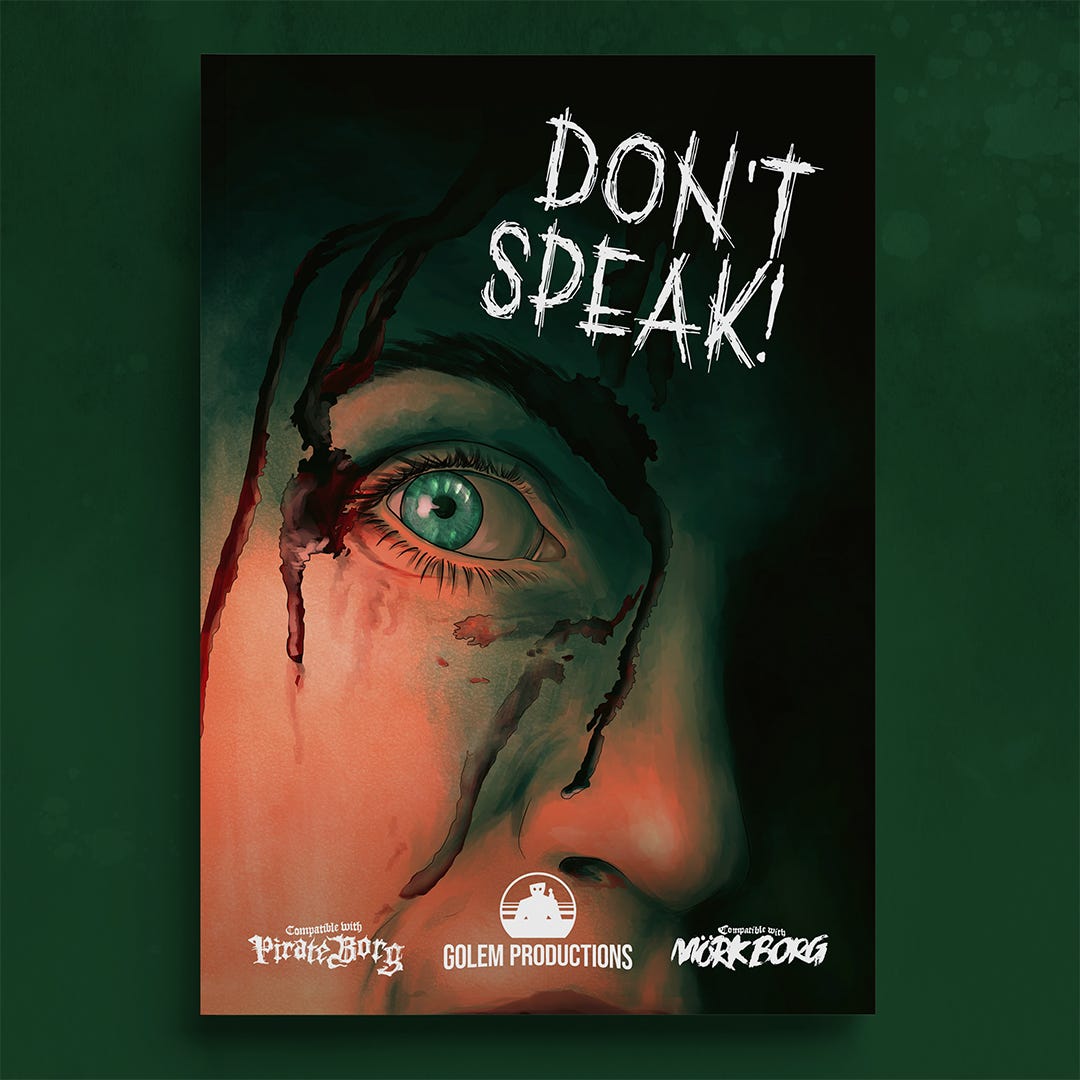
What are you playing this Halloween? We’re announcing DON’T SPEAK!, a horror one-shot rescue mission for PIRATE BORG, where the noise and silence of both your player characters and the players themselves can determine whether you make it out alive. This experimental adventure will land on DriveThruRPG and itch.io in just a few weeks. Either follow us there or keep an eye out for the announcement on this channel!
“From pebble to monolith—your journey matters. The Golems have spoken.”
Alexander from Golem Productions
Thank you for the opportunity to talk about and - most importantly - to reflect about my work and my choices with Dreadnauts. It's been as absolute blast!
This looks very cool, such a great idea for a setting, 'Moby Dick crossed with Alien' vibes. And the art is sublime!
I'm a bit confused with the Zero Edition rules though - I assumed it was a free preview zine to drum up interest ahead of the release of the complete rules but the digitial edition still costs £6. I'll probably wait until the full rules release before checking it out but definitely interested to see more in the future.