


Alright, let me admit that I struggled quite a bit with whether writing an article like this was a good idea. Potentially, I might be opening the gates of definition-hell, even though - thinking ahead and quite aware of this danger - my very first post of this blog contained this quote:
That said, we won’t engage in definition disputes or gatekeeping. We move within the creative space of people who identify with OSR, NSR, FKR, and adjacent playstyles. Diversity is important, and debates over definitions won’t serve that goal.

I still hold the view that overly pedantic debates about definitions do less to promote clarity than they do to create divisions and polarize people. As long as everyone at the table is having fun, you are doing it right. That’s a way more important principle to me than identifying with a subgenre of my hobby, says the guy who decided it was a good idea to call his blog OSR Rocks!, but we will come to that later.
So, what am I doing here? I’m going to set down what fascinates me about the OSR and how it affects our game design. But the more games I read and play, the less convinced I am that OSR alone describes what actually interests me as a designer and will inform future publications of Golem Productions. Oh, this is going to get me in trouble…
The Many Faces of the World’s Best Hobby
A few weeks ago, I listened to Elder Goblin Games’ video (see above), basically arguing in favor of reading a lot of different TTRPGs with different design approaches, intended gameplay loops, experiences, and cultures. This is exactly what I was doing over the past weeks and months. For example, I started digging into the very rules-light and rather narrative-heavy games of SoulMuppet Publishing, like Orbital Blues, Paint the Town Red, or Inevitable, just to broaden my spectrum of knowledge, learn more, and improve my skills.
And it made me realize that quite a few things I consider central to my own games don’t actually come from the OSR at all. Or, at the very least, the OSR isn’t my sole source of inspiration.
And I am not alone. The video mentioned above was a reaction to Ben Milton, who was talking about playstyles (OSR vs. Trad) in the video below, which itself was a reaction video to another one from Daði of Mystic Arts on the same topic. Okay, I’ve made that sound complicated, but it’s really just an ongoing conversation that, now, I am responding to :D
Aside from that being funny, though, there were two things I particularly liked:
These were all very respectful, constructive discussions, something I haven’t seen enough of in the past. “OSR vs. Trad” wasn’t the vibe at all. Instead, the videos presented TTRPG cultures as a spectrum, with archetypes such as Simulationists / Dungeon Crawlers closer to one end and Roleplayers / Dramatic Heroes closer to the other. Different games, and different styles of play, could then be positioned somewhere along that spectrum.
The first video in that chain was also a preview of MCDM’s Crows: Fortune or Death, which I now seriously regret not backing. (On this note: gingereno, how could you not have told me about this game !!?? How could you!?)
And I get that! If studying and travelling abroad, reading literature, working in an international company, and meeting many different people have taught me one thing, it is this: people can think, feel, act, or see the world in ways you would never have predicted, especially when various cultures, religions, or identities are involved, but even in much simpler things, too. Like how to play a TTRPG.
So where would I put myself on that spectrum?
What I Want to Keep from the OSR
Before moving toward the other end of that spectrum, let me start with the obvious: there is a reason this blog is called OSR Rocks! There are several ideas and principles I discovered through OSR games that have fundamentally changed how I think about adventures and game design.
I love how cleverly designed and interconnected good OSR dungeons are. I love that OSR games ask their players to use their wits to overcome challenges, instead of searching for a solution on their character sheets. I love how these games present interesting situations and conflicts for the player characters to freely get involved in (or not) in whatever way they choose. I love how they embrace player agency, although I also learned that not every player feels equally comfortable with that degree of freedom (see the post below). And I still remember the lasting impression these ideas made on me when I first encountered them in Old-School-Essentials and Mothership modules. These are must-haves for the games and adventures we develop in the future.

As I am also a big fan of well thought-out settings (I am deeply impressed by Emiel Boven’s The Electrum Archive), I tend toward the “OSR-style” way of thinking that the story is more about the world and setting than the individual player characters. The latter can and usually will play a big part in the story, but it is more about how the setting changes because of what happens. Emergent gameplay and narratives are also an important part in this. Players’ free choices, open dice rolls, and the plethora of weird and fantastic random tables found in many OSR books all help foster unpredictable stories that emerge naturally from play, rather than being planned in advance.
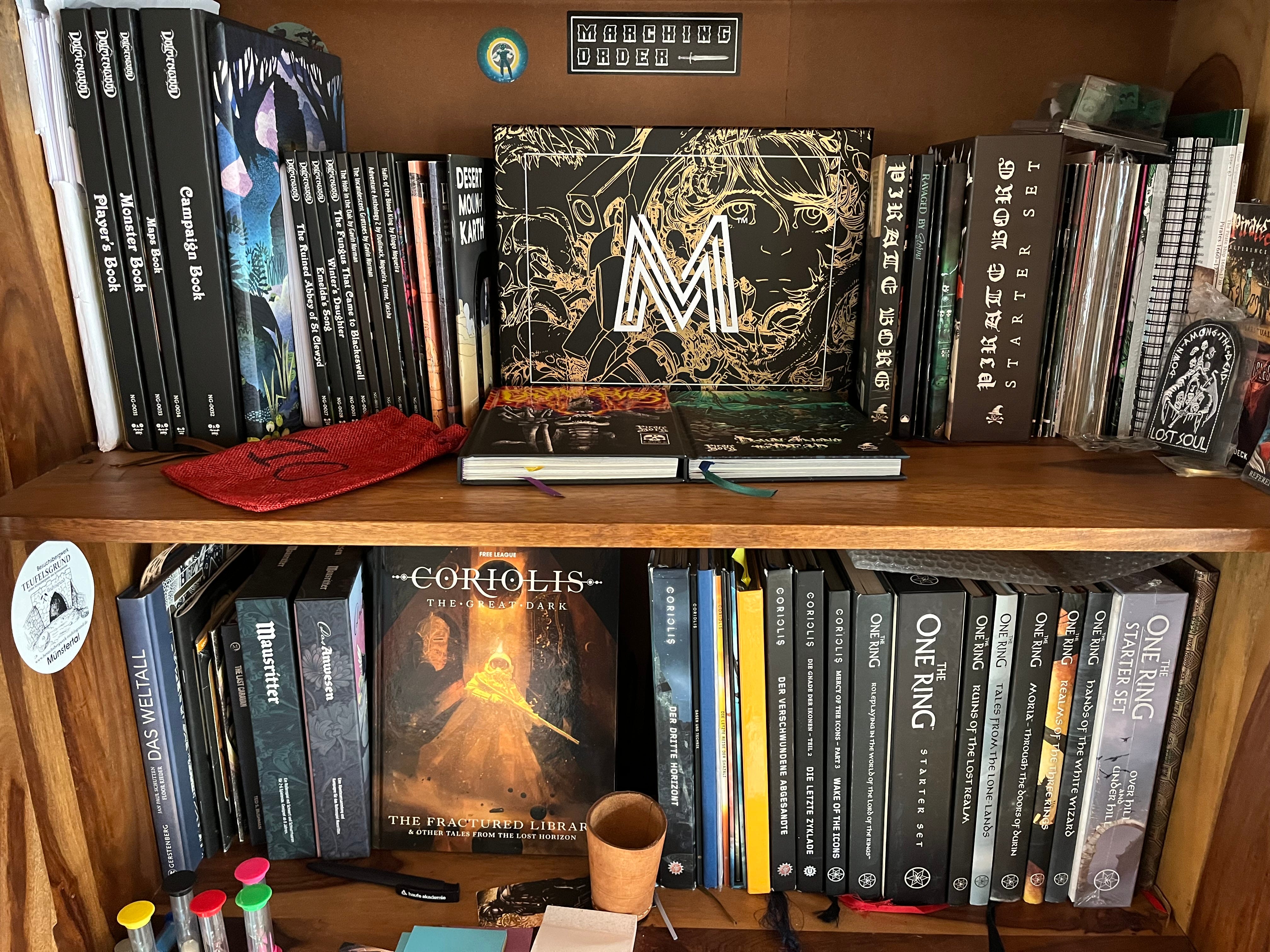
On this note, I would like to highlight the four 1st party adventures for Dolmenwood, which are Winter’s Daughter, The Fungus That Came to Blackwell, Emelda’s Song, and The Ruined Abbey of St. Clewyd. Not only do all four contain well-designed dungeons, they also show a remarkable amount of variety. More importantly, although none of them follows a prescribed plot, all four have the potential to deeply affect the wider setting of Dolmenwood. They involve important factions, secrets, and locations, and can develop or resolve some of the key conflicts already present in the setting. With that, they show that classic OSR-style “dungeon crawling” can - narratively - be way more than going in, fighting or fleeing from monster, finding treasure, and getting out.
But I Like Character Sheets, Too
Perhaps it’s because I have played many video game RPGs when I was younger, but the idea of building and advancing a character appeals to me. I very much enjoy low- to mid-levels of crunch, as in Year Zero Engine games, where you can equip cool gear and learn various talents for unique mechanical and narrative benefits. Heroic Abilities of Dragonbane or Veteran Skills of Pirate Borg, added in later supplements, qualify. It’s simply fun to unlock new options for my characters, watch them get better at what they do, and occasionally gain some cool new abilities.
However, it stops being fun when the mechanical crunch gets in the way of the story. When the complexity of rules or procedures carries so much weight that they overshadow the setting and characters of the game. 5E, Pathfinder, Shadowrun, or Draw Steel fall into that category for me.
Instead, I favor the approach of Pirate Borg (which calls itself OSR!): not everything needs a dice roll, and not every procedure needs to be followed just because it exists. The GM can zoom in and out like a movie director, deciding which moments deserve detail and which can simply pass by. Rules and random tables are tools to use when they make a scene more interesting. Bottom line: You don’t blindly follow the rules and procedures, letting them dictate the course of the session like laws would; instead, you remain in the role of the storyteller at the helm of the pacing.
I also love games that care deeply about who the player characters are, what they want, what troubles them, and how they change over the course of play. I like mechanics that reinforce a game’s themes instead of merely resolving whether an action succeeds or fails. I like it when rules actively create difficult choices, emotional consequences, relationships, or moments that would probably never emerge from a purely challenge-based approach.
What to Expect from Future Golem Productions Games
And I think that combination is getting increasingly close to what I actually want from a TTRPG: a world that does not revolve around the player characters, but a game that still cares deeply about them.
The world should exist on its own terms, with its own factions, conflicts, dangers, and secrets. It should not bend around the characters or wait for them to arrive. But the camera still follows them. Their choices, failures, relationships, discoveries, and victories are what we experience that world through.
Player skill matters to me. I want players to think, investigate, experiment, take risks, and come up with solutions that are not written on their character sheets. But character skill can and should be fun, too. Finding new gear, gaining abilities, developing strengths, or simply watching a character become better at what they do can be deeply satisfying, as long as the mechanics remain in service of the game rather than taking it over.
I want stories to emerge from play instead of being planned in advance. At the same time, I am increasingly fascinated by mechanics that gently push those stories in particular directions. Rules can reinforce themes, create difficult choices, bring relationships into focus, or make certain kinds of consequences more likely without prescribing where the story has to go.
And finally, I want the GM to remain in control of focus and pacing. Not every door needs a roll, not every journey needs a procedure, and not every minute at the table deserves the same amount of attention. But when player choices have consequences, those consequences should matter. The GM can decide where the camera points and how quickly it moves, but ideally not rewrite what happens simply because another outcome would make for a better scene.
That is probably the best description I currently have for where Golem Productions is heading. Not away from the OSR, but outward from it, taking the things I love about old-school play and combining them with ideas from other corners of this ridiculously diverse hobby.
Which, come to think of it, might be exactly why OSR Rocks! is still a perfectly good name for this blog.
Disclaimer: The article above contains DriveThruRPG affiliate links.
So where do you stand? Which design principles are absolute must-haves at your table, and which games have changed the way you think about TTRPGs?

Check out this very kind review of Ravaged by Storms at Tabletop Sentinel.
We’re getting ready for our first-ever Golem Productions booth! We’ll be at DreieichCon (November 14–15), Germany’s biggest TTRPG-only convention.
Honestly, we’re both excited and a little nervous. Hope to see some of you there!


“From pebble to monolith—your journey matters. The Golems have spoken.”
Alexander from Golem Productions
I started playing and DMing in 1979. Began world building shortly after. Our group of friends was already playing all sorts of board and strategy games, and we all took turns designing adventures and DMing. A lot of what we did was challenging each other with puzzles.
I was the most story driven of the bunch and would work the adventures around the player characters.
Still basically doing the same thing to this day. I have worked and reworked mechanics so many times over the decades that I have a streamlined version of basically first edition ad&d that I run. It all operates off of simple mathematical formulas rather than charts, while keeping the probabilities as close as practical. So I guess you'd call it NuSR.
To me the entire thing though is less about mechanics and more about style. That is 2 DM's can use the same rules, run the same published Adventure, and have very very different approaches.
The world itself can reward behavior.
Thanks for this well thought out blog post! I think I see myself experiencing the same direction as a GM and writing a Roman Borg Hack.
After having run a pirate borg campaign for over a year and playing shadowdark with colleagues, I miss some character info on the sheet for instance. I love that pirate borg characters have idiosyncrosies and those sort of things on the sheet to work with.
I always thought after having played D&D for so many years, that Pathfinder would be the way to go. But now having played that, I really dislike that crunch.
Rules light is my preference, with emergent stories and like you said, a world where the characters are in, and can matter. I would write even try to write in a hook here or there that could apply to one of the characters, but not have a whole arc for them. That's something that the players can do for themselves if they want.